
Factors Behind Composite Decking Pricing in Sustainable Projects
As a WPC extrusion technology engineer, I evaluate outdoor composite decking projects by looking beyond the board price. Composite decking pricing reflects the complete manufacturing chain, including raw material selection, formulation accuracy, production efficiency, surface quality, and long-term performance. Sustainable landscape projects require materials that balance recycled content, durability, weather resistance, and consistent appearance, so the production process has a direct influence on the final investment.
The main ingredients in WPC decking are usually wood fibre or wood powder, recycled polymers such as HDPE or PVC, additives, pigments, and processing agents. Each component affects extrusion behaviour and product stability. Higher quality recycled polymers, controlled moisture levels in wood fibre, and carefully measured additives can increase manufacturing costs but help prevent cracking, fading, water absorption, and deformation during outdoor use.
WPC Material Mixing and Pelletising Control
The first stage of production is raw material preparation and mixing. Wood components must be dried to a suitable moisture level because excessive humidity can create bubbles and weak bonding inside the finished profile. In the mixing system, the WPC formula development engineer adjusts the ratio of polymer, fibre, stabilisers, lubricants, and colour masterbatch according to the required application, climate conditions, and customer expectations.
Many factories use a two-step process with high-speed mixing followed by cooling mixing before pelletising. The blended compound is converted into pellets to improve feeding stability during extrusion. Accurate pellet quality reduces pressure fluctuations in the extruder and supports consistent board dimensions. Poor mixing or uneven pellet density often causes colour differences, surface defects, and unstable production output, which can increase waste and affect project budgets.
Extrusion Temperature Control and Mold Design
During WPC extrusion, temperature management is one of the most important technical factors. The extruder must melt the polymer evenly while protecting the wood fibre from excessive heat damage. Each heating zone has a specific setting, and engineers monitor barrel temperature, screw speed, melt pressure, and torque values throughout production. If temperatures are too high, the material may burn or lose strength. If temperatures are too low, poor plasticisation can lead to rough surfaces and weak internal structure.
The mold design determines the final shape, thickness, and mechanical performance of the decking board. A well-designed extrusion die ensures balanced material flow across the profile, preventing bending and uneven density. Mold engineers analyse pressure distribution and cooling behaviour to achieve accurate dimensions. For large sustainable landscape developments, stable extrusion performance helps maintain reliable supply and predictable composite decking pricing.
Calibrazione di raffreddamento e tecnologia di trattamento superficiale
After leaving the extrusion die, the hot WPC profile enters the cooling calibration system. Vacuum calibration tables maintain board dimensions while water cooling gradually reduces temperature without creating internal stress. The calibration process influences straightness, width accuracy, and installation compatibility. Incorrect cooling speed can result in warping, shrinkage, or profile distortion, creating difficulties for installers and contractors.
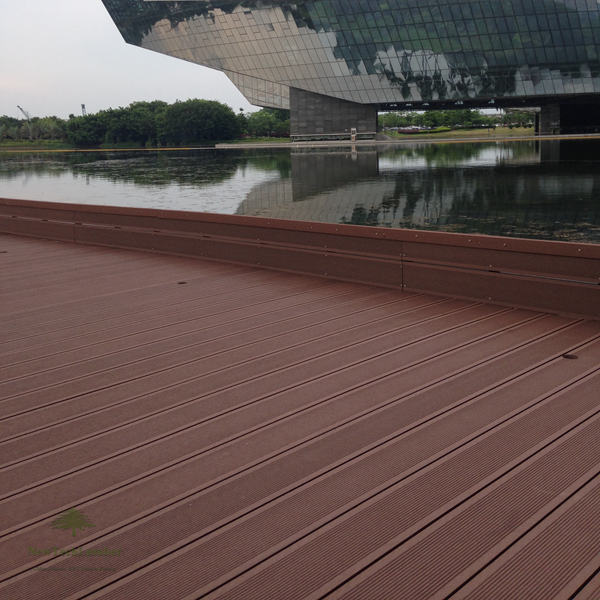
Surface treatment gives composite decking its final appearance and functional properties. Embossing rollers can create realistic wood grain textures, while sanding equipment improves coating adhesion and surface consistency. Some products receive co-extrusion protection layers that improve resistance against ultraviolet exposure, stains, and moisture. These additional manufacturing steps contribute to the final product value and help explain differences between basic and premium decking options.
Production Challenges Affecting WPC Deck Performance
Common WPC extrusion problems include colour variation, board deformation, surface cracking, poor screw feeding, and unstable dimensions. Colour problems may result from inconsistent pigment dispersion or recycled material variation. Cracks can appear when the formula lacks sufficient compatibility between polymer and wood fibre. Deformation is often linked to incorrect cooling calibration or unsuitable extrusion parameters.
Quality control teams work closely with extrusion engineers to inspect density, hardness, impact resistance, water absorption, and appearance. Production management also monitors equipment maintenance, material storage conditions, and packaging methods. Proper packaging design is particularly important for export markets because long-distance transport can expose decking boards to pressure, humidity, and temperature changes.
Manufacturing Knowledge Supports Better Landscape Planning
For architects, landscape consultants, and international buyers, understanding the WPC extrusion process provides a clearer view of material selection and project costs. Sustainable outdoor applications depend on reliable manufacturing standards rather than only comparing initial purchase prices. Factory capability, formula experience, production control, and after-sales support all influence the practical value of composite decking.
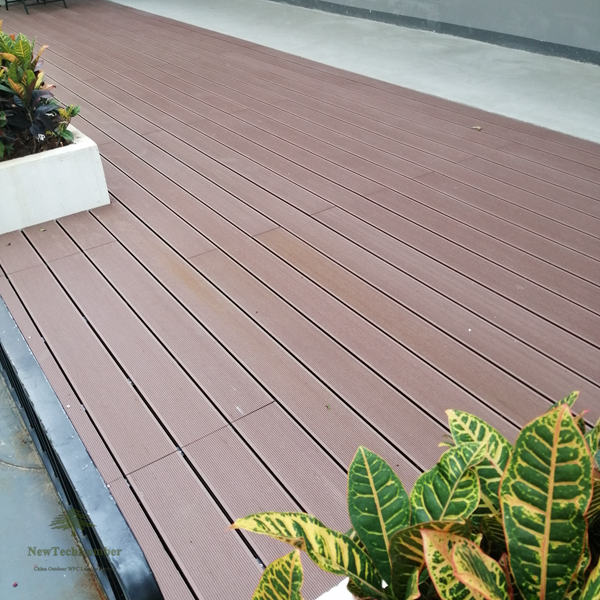
A professional WPC factory evaluates every stage from raw material preparation to final inspection to deliver stable products for residential terraces, commercial landscapes, and public outdoor spaces. By connecting engineering decisions with project requirements, buyers can assess composite decking pricing more accurately and select solutions that provide dependable performance throughout the service life of the installation.