
> Worked for a couple of seconds
{“content_html”:”
Pre Shipment Inspection Starts With Raw Material Control
As a WPC quality inspection supervisor, I treat every shipment as a process that begins long before the finished wall panels are packed. The installation of wpc wall panel depends heavily on consistent material quality, because small variations in profile size, density or moisture behaviour can become visible during fitting. Before production starts, the incoming wood fibre, polymer, additives and colour masterbatch are checked against the approved formula. Moisture content, fibre condition and material cleanliness are monitored, while production records are reviewed to confirm that the specified formulation is being used.
During extrusion, samples are taken at controlled intervals rather than relying only on the first production pieces. The extrusion temperature, line speed, cooling conditions and profile dimensions are recorded. This approach helps identify gradual changes caused by equipment temperature drift, material feeding variation or cooling problems. For outdoor WPC wall panels, stable production conditions are especially important because the products must withstand changing temperature, humidity and sunlight after installation.
Dimensional Accuracy Must Match Installation Requirements
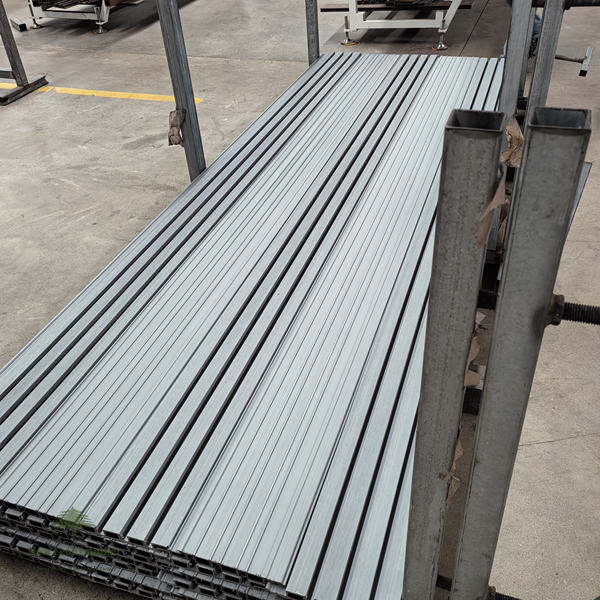
Dimensional inspection is one of the first finished product checks. Each selected WPC wall panel is measured for length, width, thickness, profile geometry and, where relevant, tongue and groove or clip fitting dimensions. Calipers, steel rules, gauges and calibrated measuring equipment are used according to the product specification. Measurements are compared with approved tolerances rather than judged by appearance alone.
Panel straightness and profile consistency also receive close attention. Excessive bowing, twisting or variation between batches can create uneven joints and make the installation of wpc wall panel unnecessarily difficult. Inspectors therefore check representative samples along their full length and examine whether connecting sections engage correctly. Consistent dimensions help installers maintain joint spacing, alignment and a clean finished surface without excessive adjustment on site.
Density, Bending Strength and Impact Resistance
Density testing provides useful evidence of extrusion consistency. Samples are weighed and their volume is determined so that density can be compared with the approved product range. An abnormal density result may indicate changes in the wood polymer ratio, foaming behaviour, moisture level or extrusion conditions. Density is not assessed in isolation, because a suitable WPC product must also deliver the required mechanical performance.
Bending strength testing evaluates how the panel responds to a controlled load and helps identify weak or poorly fused material. Impact resistance is assessed using the specified test method to determine how the profile reacts to sudden force. These tests are particularly relevant to outdoor applications where panels may experience accidental knocks, handling stress and repeated environmental movement. The inspection supervisor records test conditions and results so that production batches can be traced if a result falls outside the agreed specification.
Water Absorption and Outdoor Moisture Performance
Water absorption is another important quality indicator for WPC wall panels. Test specimens are weighed before exposure and then conditioned in water according to the relevant testing procedure before being weighed again. The change in mass indicates the amount of water absorbed. Excessive absorption can be associated with material formulation, internal voids, poor processing or inadequate surface structure, and may affect dimensional stability during long term outdoor use.
Inspection records should also distinguish between normal material behaviour and defects. A panel designed for exterior use should not be judged solely by whether it absorbs any water, because WPC is not necessarily completely impermeable. The key requirement is that absorption remains within the agreed specification and does not cause unacceptable swelling, distortion or loss of performance. This information supports engineers and installers in selecting suitable fixing methods and allowing appropriate movement gaps.
Renk İstikrar ve Görünüm Denetimi
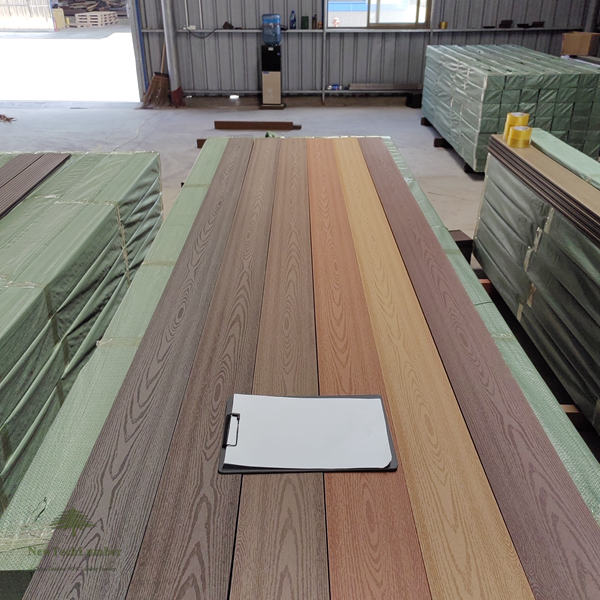
Colour stability is checked because outdoor WPC products are exposed to ultraviolet radiation, rain and temperature changes. Approved colour samples are retained as references, while finished panels are compared under consistent lighting conditions. Where required, accelerated weathering tests are used to assess colour change after controlled UV and moisture exposure. The inspection focuses on whether fading or colour variation remains within the agreed acceptance level.
Appearance inspection is carried out across the visible surfaces and profile edges. Inspectors look for scratches, cracks, chips, bubbles, black spots, foreign particles, uneven texture, poor embossing, colour streaks and other production defects. Panels are checked from a practical viewing distance under suitable lighting rather than inspected only at a very close range. Batch identification, quantity and packaging condition are recorded alongside the visual results, providing traceability if a customer reports a problem after delivery.
Final Release Checks Protect Installation Quality
Before shipment, the quality inspection supervisor reviews dimensional records, density data, impact and bending results, water absorption measurements, colour stability evidence and appearance inspection records. Samples must represent the actual production batch, and any nonconforming material should be segregated rather than mixed with approved goods. Packaging is also checked to ensure panels are protected from moisture, abrasion and deformation during storage and international transport.
A well controlled release procedure gives distributors, project managers and installation technicians greater confidence that the panels arriving on site match the approved specification. For the installation of wpc wall panel, quality begins with repeatable manufacturing and ends with careful verification before dispatch. Accurate profiles, stable mechanical properties, controlled water absorption, reliable colour performance and clean surfaces provide the foundation for efficient fitting and a consistent exterior finish.
“,”tags”:[“WPC wall panels”,”WPC quality control”,”WPC testing”,”outdoor WPC”,”panel installation”],”topic”:”wallpanel”}