
Composite Decking Cost Factors From WPC Raw Material Selection
As a raw material quality control engineer in an outdoor WPC factory in Guangdong, China, I evaluate every incoming material batch before it enters production. The comparison of composite decking vs pavers cost is not only based on purchase price. Long term value depends on material stability, service life, maintenance requirements, and resistance to outdoor conditions. A correctly formulated WPC decking board can reduce replacement frequency and provide consistent performance for residential, commercial, and landscape projects.
Wood powder is one of the main components that defines the appearance and mechanical behaviour of WPC products. Our factory checks wood powder moisture content, particle size distribution, cleanliness, and fibre quality before mixing. Excessive moisture can create internal defects, while inconsistent particle sizes may affect extrusion pressure and surface quality. High quality wood powder improves natural texture, dimensional stability, and the bonding effect between wood fibres and polymer materials.
Polymer Quality Control For Outdoor WPC Durability
HDPE and PVC polymers provide the structural foundation of composite decking. HDPE is commonly selected for outdoor applications because it offers strong impact resistance, low water absorption, and good flexibility. PVC formulations can provide high stiffness and dimensional accuracy when properly balanced with stabilisers and processing additives. Our inspection process includes checking polymer grade, melt flow performance, density, and compatibility with other raw materials.
The polymer ratio directly influences board strength, expansion behaviour, and resistance to temperature changes. In our Guangdong production facility, extrusion trials are carried out to confirm that the compound flows evenly through the mould. We inspect board surfaces for bubbles, cracks, colour variation, and deformation after cooling. These factory controls help ensure that finished decking performs reliably in different climates, including humid coastal regions and areas with strong sunlight exposure.
Additives Pigments and Modifiers For Weather Resistance
Additives are essential for improving the outdoor performance of WPC decking. UV stabilisers protect pigments and polymers from degradation caused by long term sunlight exposure. Lubricants improve extrusion efficiency and surface smoothness, while coupling agents strengthen the connection between wood powder and plastic materials. Impact modifiers are also tested because they can improve toughness and reduce cracking risks during installation and daily use.
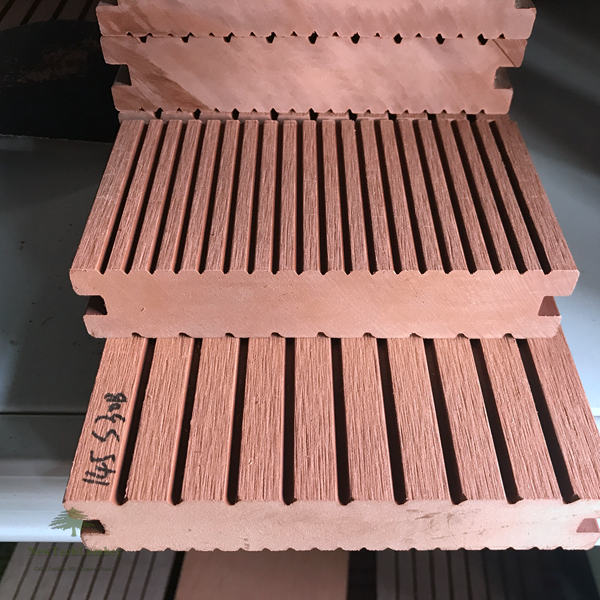
Pigments must be carefully selected to maintain colour stability throughout the product lifespan. Our quality team performs accelerated weathering tests, colour difference measurements, and surface inspection to evaluate ageing resistance. A professional WPC manufacturer does not judge quality only by appearance after production. We examine how the material behaves after heat cycles, moisture exposure, and ultraviolet testing. These results provide practical evidence for architects, designers, and international buyers comparing outdoor material options.
Factory Inspection Standards For WPC Decking Performance
Quality inspection in a WPC factory covers every stage from raw materials to finished boards. Incoming inspection records are created for wood powder, HDPE or PVC polymers, additives, and pigments. During production, technicians monitor extrusion temperature, pressure, cooling speed, and board dimensions. Finished products are tested for density, flexural strength, water absorption, impact resistance, and surface hardness.
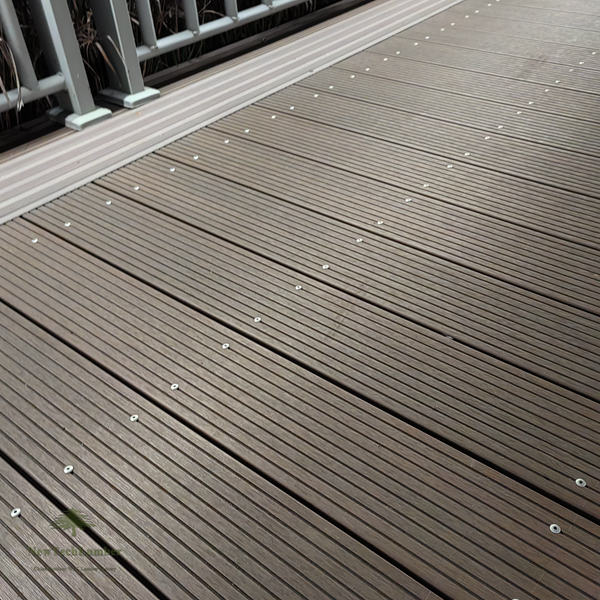
Our inspection standards also include checking colour consistency between production batches, locking system accuracy, and profile dimensions for installation compatibility. Samples are stored for traceability, allowing engineers to review performance data if customers require technical support. These procedures are especially important for OEM projects where customised colours, profiles, and packaging solutions must meet strict international expectations.
Material Value Comparison For Global Outdoor Projects
For buyers researching composite decking vs pavers cost, WPC decking offers a different value structure from traditional paving materials. Pavers may have lower initial material costs in some applications, but installation labour, surface maintenance, drainage requirements, and future repairs can affect the total project budget. WPC decking provides a lightweight system with consistent dimensions and easier installation methods, which can benefit large outdoor projects.
From a manufacturing perspective, the final performance of composite decking depends on disciplined raw material management rather than a single ingredient. The balance between wood powder, polymers, additives, pigments, and modifiers determines whether a product can withstand years of outdoor exposure. Professional quality control enables WPC factories to supply decking solutions that meet the needs of landscape engineers, architects, distributors, and international construction markets.